Komon Sajbichil.
The project employs collaborative methodologies that articulate the research process at every phase: from initial design to writing, review, and dissemination. Furthermore, exchanges based on Ixil logics of reciprocity have been fostered to contribute to the construction of a new future, rooted in Komon Sajb’ichil.
Community work began with the Ixil University and the Ixil Ancestral Authorities, elected representatives of the municipalities of Nebaj, Cotzal, and Chajul in El Quiché.
In 2011, the Ixil Ancestral Authorities founded the Ixil University to create their own forms of knowledge and education. By integrating Maya wisdom rooted in local values and tiichajil (the good life), they sought to challenge the ways in which state education has incorporated Indigenous peoples into national cultures and justified physical and geographical violence.
Our research programme has developed through constant dialogue with the Ixil Ancestral Authorities and the Rector of the Ixil University. Initially, we held online meetings to explore collaboration possibilities and define objectives, methodologies, and timelines.
Based on these discussions, Dr Gibbings and Dr Flores developed a proposal, and in July 2022 travelled to Nebaj to discuss the preliminary research plan with Feliciana Herrera Ceto of the Ancestral Authorities and Pablo Ceto, the Rector of the Ixil University.
Once funding was secured, the Rectorate of the Ixil University and the Ancestral Authorities of the Ixil region approved the final version of the project plan and supported the research funding application on 11 July 2022.
In the summer of 2023, a series of workshops was held in Nebaj. Twenty Ixil participants were selected by the Ancestral Authorities and the Ixil University to take part in a training process on the history of cartography prepared by Dr Gibbings.
They studied the history of state cartography from the colonial era to the present, with special emphasis on the Ixil region. Indigenous forms of mapping were also analysed, particularly the Lienzo de Quauhquechollan, and discussions began regarding Ixil mapping technologies and practices.
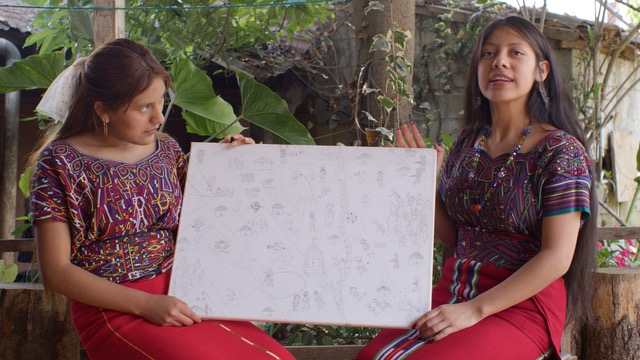
From these twenty participants, eight Ixil researchers were selected to visit archives in Guatemala City and subsequently conduct oral history research in their communities. Based on their work, they created a series of memory maps that combine Ixil symbolisms, archiving and representing memory and history.
We acknowledge the importance of the AHRC Indigenous Partnerships funding scheme, which respects the timeframes, processes, and outputs associated with collaborations with Indigenous institutions.